A Quiet Hour for Watching a Place’s Screens
A quiet hour observing public screens can show how local information fits a venue’s routines, while keeping notes focused on displays rather than visitors.
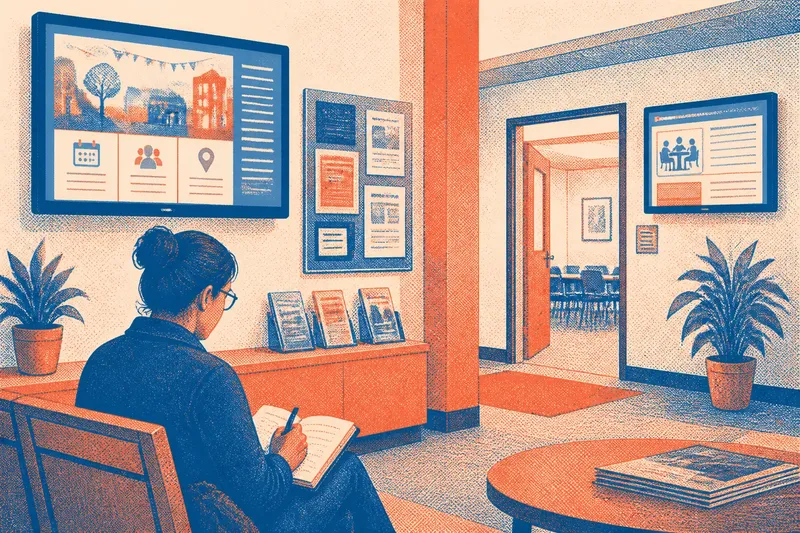
A quiet hour observing public screens can show how local information fits a venue’s routines. In a library foyer, community centre or covered market, the useful subject is how displays serve the place—not what individual visitors think or do.
Choose your method by the question you want to answer. Focus on one screen to understand its content and rhythm, compare displays to see how their roles differ, or take a route when the relationship between screens and the whole venue matters most.
Choose a method that matches your question
A focused observation suits a question about one display: what kinds of information appear, how items are arranged, and whether the screen changes during your visit. It gives you more detail about that display, but less context about other parts of the venue.
Comparing screens is better when they occupy distinct areas, such as a library entrance and a community room. A route through the venue is better when you want to understand how displays fit into its layout. The trade-off is simple: focus brings detail, comparison brings contrast, and a route brings context.
Decide on one method before you begin. A clear question, such as “How does the entrance display share local events?”, gives your notes a purpose without turning the visit into a search for unusual moments.
Set boundaries before taking notes
Choose a place where you can sit or stand without blocking a doorway, counter or accessible route. A public bench or open seating area may work; avoid staff workspaces and follow any venue rules about note-taking or restricted areas.
Keep notes about the display and its setting, not identifiable people. Do not record names, faces, conversations, appointment details, health information or other private material, and avoid photographs or recordings that could capture visitors as well as screens.
A small notebook can hold brief descriptions such as “near the entrance” or “shares space with event posters”. If note-taking would feel conspicuous, make a short record after leaving. There is no need to count viewers or track anyone’s movements.
Separate screen content from the conditions around it
Describe the content in broad terms: a community event notice, a welcome message, local artwork or directions. Avoid copying text if it could contain personal details. This keeps the focus on the display’s public purpose rather than private information.
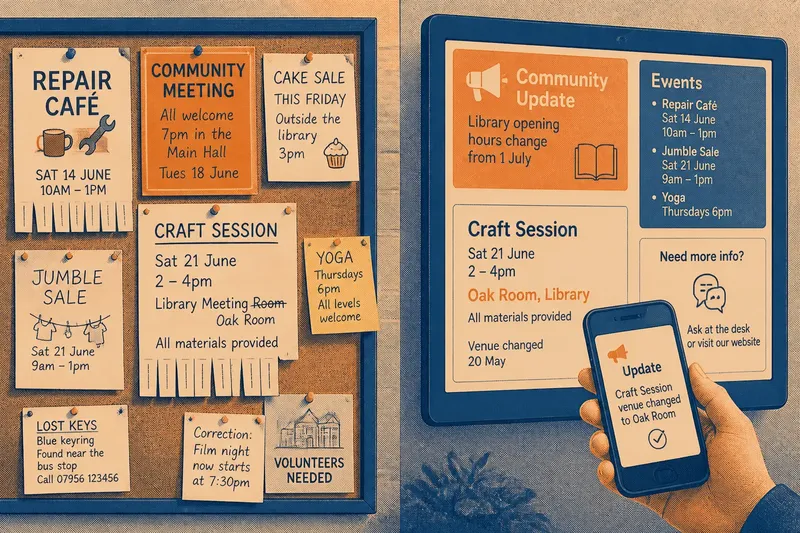
Then note the conditions that shape how the screen works as part of the venue. For instance, it may show a rotating list of community events beside a printed noticeboard, while a reception desk directs visitors elsewhere. That points to a useful question about how the venue shares information across formats; it does not tell you what any particular visitor noticed.
Keep description separate from interpretation. “The screen shows an event listing beside the entrance” is observable. “Visitors prefer the printed notices” is a claim about people that a quiet observation cannot establish.
Questions that help you plan the visit?
What should I note when I focus on one display?
Record its general content, how the items are presented and any change you notice during your visit. Keep the notes about the screen and the venue, not the people who pass by.
When is comparing screens more useful than following one?
Compare displays when they occupy different parts of a venue or appear to serve different purposes. A screen near an entrance and one beside a meeting room can reveal how the venue distributes public information, without requiring observations about visitors.
How can I describe a screen’s role without guessing?
Write down what is directly visible, such as its location and the type of material it carries. Treat possible explanations as questions for venue staff or organisers rather than conclusions about audience behaviour.
What should I do if private information appears?
Do not copy, photograph or repeat it in your notes. Leave it out and return to general details about the display, or move on if the setting no longer feels appropriate.
Work through a comparison with a clear question
Imagine you arrive at a community centre with a screen in the foyer and another outside a meeting room. Your question is whether the venue places its general announcements and room-specific information in different areas. First, note only broad content categories on each screen, without copying names or event details. Next, describe where each display sits in relation to public areas. Finally, compare the notes: if the foyer screen carries general notices and the meeting-room screen carries room information, you can report that the displays have distinct apparent roles. You cannot conclude who read them or whether the notices reached their intended audience.
This approach makes the result useful to a venue without making visitors the subject. If your notes do not support a clear distinction, say so; an inconclusive comparison is more accurate than assigning a purpose the display may not have.
Keep the record descriptive and useful
Before leaving, check each note for a claim about what someone wanted, understood or ignored. Replace it with an observation about the display’s content or place in the venue, or remove it if it cannot be supported.
- Check whether a note names or identifies a visitor; if it does, remove that detail, or keep the note only if it describes the display without identifying anyone.
- Check whether you copied personal information from the screen; if you did, delete it, or retain only a broad category such as “appointment notice” when that is appropriate and non-identifying.
- Check whether a sentence describes an observable feature; if it does, keep it, or rewrite interpretations about audience preferences as questions for venue staff.
- Check whether your chosen method answered your original question; if it did, retain the relevant notes, or narrow the account to what you actually observed.
- Check whether note-taking followed the venue’s stated rules; if it did, keep the record, or stop and remove notes made in a way the venue does not permit.
- Check whether the notes could help explain how a display fits the venue; if they could, share them with relevant organisers, or leave them private if they contain details that do not belong in a public account.
A quiet hour observing public screens is most useful when it leaves a clear, modest record: what the displays show in broad terms, how they fit the venue, and what questions remain open. That gives community organisers something concrete to discuss while respecting the people who share the space.